
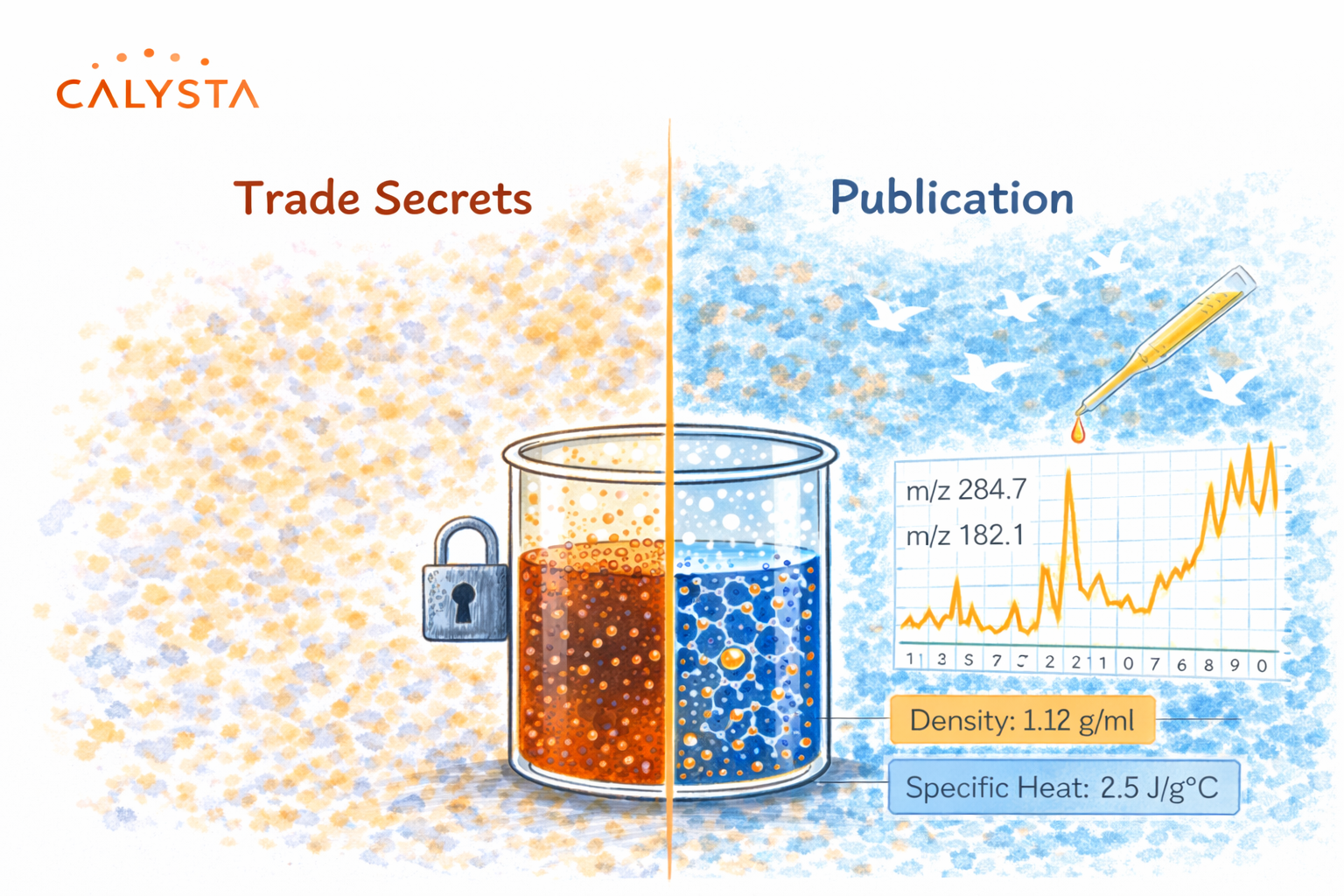
Trade Secrets vs. Prior Art
Why G 1/23 Changes the Game for Your IP Strategy
For more than 30 years, a fundamental question has troubled patent practitioners: can a product that is commercially available, but whose “recipe” is protected as a trade secret, be used to invalidate a patent?
The Coca-Cola example was often cited as the borderline case. With decision G 1/23, issued by the Enlarged Board of Appeal following referral T 0438/19, the European Patent Office has now given a clear and authoritative answer.
- The Starting Point: The T 0438/19 Dilemma
The case originated in a dispute between Mitsui Chemicals and Borealis concerning a material used in solar cells. The opponent, Borealis, relied on a commercially available polymer—ENGAGE® 8400—as the closest prior art in order to challenge inventive step.
The patent proprietor, Mitsui, raised a powerful counter-argument. The polymer was said to be so complex that its internal structure and exact manufacturing process could neither be fully analysed nor reproduced without an undue burden. Relying on earlier case law, in particular G 1/92, Mitsui argued that if a product cannot be reproduced, it should not be considered as forming part of the state of the art.
Faced with diverging interpretations in the case law, the Technical Board of Appeal referred fundamental questions of law to the Enlarged Board.
- The Clarification Brought by Decision G 1/23
The Enlarged Board firmly rejected the idea that a physical product on the market could be ignored by patent law. Its reasoning is both pragmatic and pedagogical.
First, the Board put an end to what it described as a legal fiction. Excluding a real, commercially available product from the state of the art would lead to an absurd result, where something that undeniably exists would be treated as legally non-existent for the skilled person.
Second, the Board confirmed that physical availability equals public availability. As soon as a product is placed on the market, it is made available to the public within the meaning of Article 54 EPC. This is independent of whether the manufacturing process is known, documented, or reproducible.
Finally, the Board clarified that everything that is analysable is public. All technical features that a skilled person can derive from the product using standard analytical methods form part of the state of the art.
Returning to the Coca-Cola example discussed during the proceedings: even if the secret formula remains unknown, the fact that the drink exists, is carbonated, and contains caramel is public technical information belonging to the state of the art.
- Practical Guidance for Your IP Practice
This decision has concrete consequences for daily patent practice, whether you are drafting, filing, or litigating.
When conducting prior art searches, commercially available products can no longer be treated as secondary sources. Even if a competitor does not publish patents, its products on the market may constitute highly relevant prior art. If their properties or structure can be analysed, they may destroy novelty or inventive step.
The decision also confirms the importance of technical brochures and datasheets. Properties such as density, hardness, or thermal behaviour disclosed in marketing materials are part of the state of the art, even if the product itself cannot be fully reproduced.
When drafting patent applications, the focus should shift decisively towards inventive step rather than relying on the secrecy of an underlying product. Improving a “secret” product will not, by itself, confer patentability. The claimed invention must solve a technical problem in a non-obvious manner over what the skilled person can already derive from the existing product—for example by delivering a demonstrable functional effect such as reduced emissions, improved efficiency, or a lower glycaemic index.
Precision in measurement methods also becomes critical. Since analysable features are prior art, defining specific test methods and parameters in the specification is often key to establishing a technical distinction over commercial products.
In opposition and litigation, arguments based solely on non-reproducibility are now significantly weakened. The decisive question is no longer whether the product can be recreated, but what the skilled person can realistically learn from it using available analytical tools.
Conclusion
Decision G 1/23 brings welcome clarity: market reality prevails over manufacturing secrecy. For IP practitioners, this means increased vigilance towards competitors’ products, which must now be treated as technical disclosures on par with patent literature. In short, trade secrets no longer shield commercially available products from becoming powerful prior art.